Multigenerational Workplace Statistics: USA 2026
Corporate leaders talk publicly about what it takes to run a multigenerational workplace, and that conversation is a useful record of what they are discussing. This page collects 16 findings on how prepared they say they are to lead a multigenerational workforce, how they run mentorship and feedback, where they see a technology gap opening, and which generation is hardest to keep.
A multigenerational workplace is one where several generations work alongside each other, each arriving with different habits around communication, feedback, technology, and what a career is supposed to look like.
Organizations that handle it well tend to treat those differences as information rather than a problem to be managed away. They give leaders a clearer way to think about hiring, mentoring, and retention without reducing anyone to the decade they were born in.
How to read these numbers
This is an analysis of public conversation, not a survey, and is purely for informational purposes to advance perspective and insights into the multigenerational workplace. Artios gathered the data and information by exploring 535,510 comments/opinions from corporate C-suite leaders in the United States shared online across X, Quora, Reddit, Bluesky, TikTok, and Threads over the 12 months ending 14 August 2026. These were public postings so no one was specifically asked a question, unlike a standard quantitative research study. The percentages reflect opinions people volunteered publicly online, which differs from a representative sample completing a fielded instrument with a specific degree of rigor, a clearly defined methodology, a stated margin of error, and a traditional quantitative research approach.
That distinction matters for how much weight any single figure can carry, yet it can be directionally helpful and informative for trends and points of view. Public online conversation tends to over-represent people with strong views and under-represent those with no strong motivation to post. The bottom line is that these are interesting directional findings that can spark further conversation, academic exploration, and traditional research approaches rather than statements of hard facts.
For comparison, the national and international research studies designed, led, analyzed, and published by The Center for Generational Kinetics are specifically created, participant-weighted, fielded, and analyzed with rigor to a highly specific sample and usually weighted to the U.S. Census or another Census benchmark depending on the geography or participant group focus. The research-based insights uncovered by The Center for Generational Kinetics are more rigorous in design, scope, fielding, and analysis, and we label them as such wherever they appear.
Index
- Methodology and data.
- 95% of corporate C-Suite leaders are well prepared to lead a multigenerational workforce, compared with 5% who are not.
- Conflicting work values are a significant multigenerational workplace challenge for 52% of corporate C-Suite leaders; 18% also find career expectation mismatches a significant challenge, while 31% find technology adoption gaps a minor challenge.
- 85% of corporate C-Suite leaders agree that career development opportunities are the most important benefit across generations in the workplace, and 3% think they are a significant benefit; 7% agree flexible work arrangements are the most important benefit, and 3% agree they are significant, while fewer than 1% mention the benefits offered by mental health or higher compensation in a multigenerational workforce.
- For 24% of corporate C-Suite leaders, it’s somewhat true that older staff prefer working in the office, while this isn’t really true for 39%, and it’s not true at all for 4%, and 33% agree that it’s not really true that hybrid work preferences are evenly mixed.
- Slack or instant messaging is the preferred workplace communication across generations for 81% of corporate C-Suite leaders, and 19% of all generations in the workplace prefer in-person communication.
- Scheduled one-on-ones are the preferred feedback format for 51% of generations at corporate C-Suite leaders’ companies, and 49% prefer written or documented feedback.
- 69% of corporate C-Suite leaders say leadership style shifts by generation, with more collaboration noted among younger staff; 30% see a consistent leadership style across all levels; 1% agree leadership is adapted on a case-by-case basis; and no one mentions leadership that’s more directive for older staff.
- 37% of corporate C-Suite leaders address generational stereotypes informally, on a case-by-case basis; 35% have not considered handling these stereotypes, 27% don’t actively address them, and only 1% address generational stereotypes in training.
- 72% of corporate C-Suite leaders approach mentorship across generations by implementing peer-to-peer mentoring; 11% use reverse mentoring programs, and 6% rely on traditional top-down mentoring, while 10% have no formal mentorship program in place.
- For corporate C-Suite leaders, 2% of Baby Boomers are absolutely the main driver behind AI tool adoption, and 4% agree they’re likely, but 51% say they’re not the main drivers in this regard, Gen X is absolutely the main driver for 5%, and 5% find them likely to be, yet 12% disagree, Gen Z is the driver behind AI tool adoption for 4% but not for another 4%, Millennials follow with 5% driving adoption and 3% not really doing so, and 5% don’t see a clear generational leader in the adoption of AI tools.
- While 40% of corporate C-Suite leaders find that younger employees adopt AI faster, 38% point to older generations as the faster adopters; 20% say it’s too early to tell; and 1% say adoption is fairly even across all generations.
- 33% of corporate C-Suite leaders see a major gap in generational use of AI and automation tools, 10% see some gap, 12% a minor gap, and 7% see no gap at all, while 14% spot a major tech tool gap in collaboration platforms and 8% see some gap; there’s a major gap in project management and software use for 5%, and some gap for 2%, but only a minor one for 3%, while communication apps reveal some gap for 2%, and 1% don’t really see a significant tech tools gap.
- For 30% of corporate C-suite leaders, the best recruiting channels for each generation vary heavily, and 19% agree some tools are stronger contenders than others, and 3% find social media platforms to be a strong contender, but it’s not the top choice of recruitment channel for 16%, and it doesn’t work well for 24%, while job boards or LinkedIn are not a top choice for 2%, and don’t work well for 3% for corporate C-suite leaders.
- 5% of corporate C-Suite leaders agree that Millennials are definitely the hardest generation to retain right now, and 54% find them to be probably the hardest to retain, compared to 27% who don’t find Millennials the hardest generation to retain, and 8% who definitely don’t find them the hardest, while 3% agree Baby Boomers are probably the hardest to retain, and there are no mentions of struggling to retain Gen Z or Gen X.
- 25% of corporate C-Suite leaders are very confident in their succession plan, and 25% are somewhat confident; however, 25% are not very confident in their plan, and 25% have no succession plan.
- 34% of corporate C-Suite leaders are very optimistic about their multigenerational workplace future, and another 34% are somewhat optimistic; yet, 32% are very concerned about their workplace future.
- Building stronger multigenerational workplaces.
How prepared are leaders to lead a multigenerational workplace?
95% described themselves as very prepared to lead a multigenerational workforce. 5% said they were not very prepared.

Two things make this number smaller than it looks.
The first is the question itself. Only two options were recorded: very prepared and not very prepared, with no middle. A leader with ordinary doubts has nowhere to put them, and self-description in public tends to round upward.
The second is what happens when research asks about readiness rather than confidence. Deloitte’s 2020 Human Capital Trends study found 70% of organizations calling a multigenerational workforce important or very important to their success, while only 10% felt ready to address it.
Those are different samples, different methods, and six years apart, so you can’t subtract the two numbers. They can still be read side by side, and side by side they describe a familiar shape: leaders who feel prepared, and organizations that are not.
The more reliable test is internal. This sample describes itself as prepared, and then describes what it has actually built, and the two do not always agree. Read every finding below with that in mind.
The scale of what they are preparing for is real. Today’s workforce spans six generations. The youngest members of the Silent Generation turn 81 in 2026, and the oldest members of Generation Alpha are reaching the age of first jobs and internships. Between them sit Baby Boomers, Generation X, Millennials, and Generation Z.
What is the top multigenerational workplace challenge?
Conflicting work values were called a significant challenge by 52%. Technology adoption gaps were called a minor challenge by 31%, and career expectation mismatches a significant challenge by 18%.
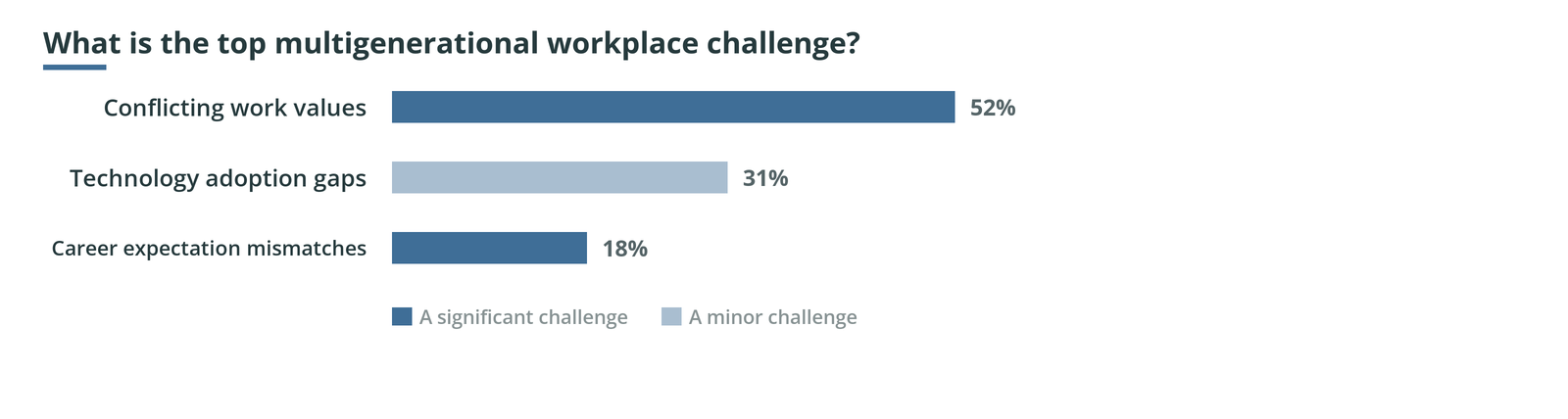
Values came up first and came up hardest. That matches research on work values across generations, showing younger workers placing more weight on development, reward, and stimulation, and older workers on clarity and structure. Those differences surface as arguments about process rather than arguments about values, which is part of why they are hard to name in the room.
Technology adoption came second and, notably, came second as a minor challenge. Nobody in this sample described it as significant. Hold that thought, because two sections later the same group describes a major generational gap in AI and automation tools. The two answers are hard to reconcile.
Career expectation mismatches are the smallest of the three and the most concrete: what counts as a promotion, how long a rung should take, and who is responsible for training.
Which benefit matters most across generations?
Career development opportunities were named the most important benefit by 85%, ahead of flexible work arrangements at 7%. Mental health support and higher compensation were each named by fewer than 1%.
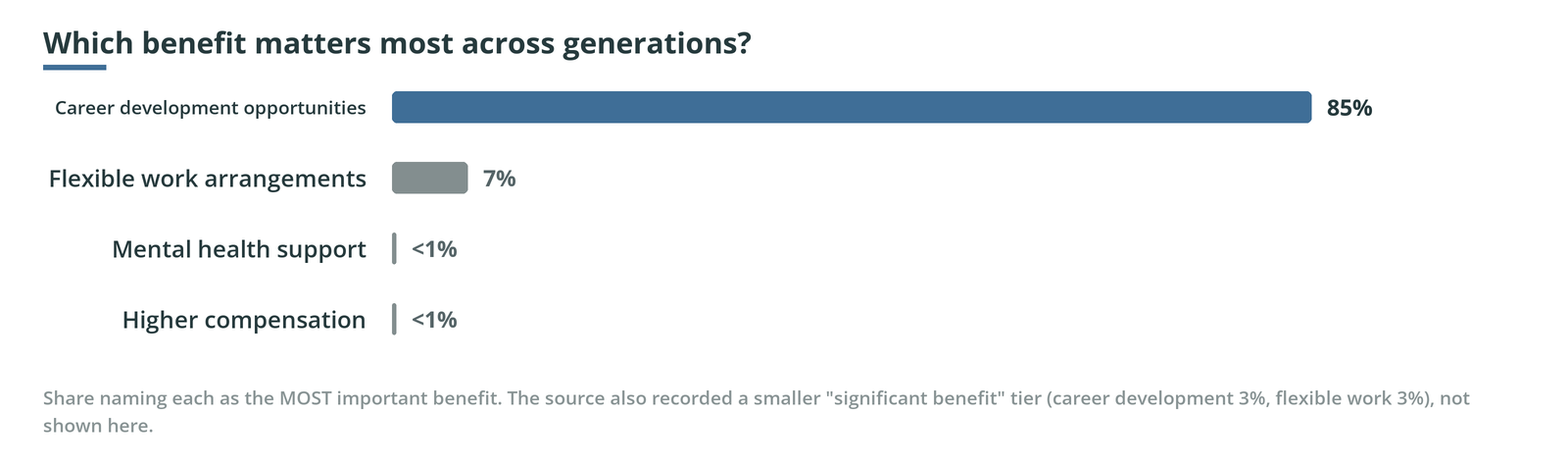
An 85% concentration on one answer is unusual and warrants careful treatment. It says that when these leaders discussed benefits in public, development was overwhelmingly the focus. It does not establish that their employees rank it first.
Development is a defensible focus. LinkedIn’s research found 94% of employees would stay longer at a company that invests in their careers, and development is one of the few benefits that reads differently at every career stage while still being the same benefit.
The bottom of this chart deserves more suspicion than the top. Compensation registering below 1% is not evidence that pay has stopped mattering. It shows that corporate C-suite leaders don’t post about pay, which is a different finding and a more predictable one.
Is the hybrid work split really generational?
Asked whether older staff prefer working in the office, 24% said somewhat true, 39% said not really true, and 4% said not true at all. A further 33% said it is not really true that hybrid preferences are evenly mixed.

The stereotype does not hold up in its own sample. Combined, 43% pushed back on the idea that older staff prefer the office, compared with 24% who partly agreed.
This is also the section where the source draft went wrong, and the chart settles it. The draft read the 33% as leaders saying preferences are evenly mixed. The chart shows that 33% say it is not really true that preferences are evenly mixed. The correction matters, because the original reading turns a rejection into an endorsement.
Outside evidence lands in the same place. Research from the Institute for Public Relations found 23% of Gen Z preferred fully remote work, compared with 35% of Millennials, Gen X, and Baby Boomers. The generation most often assumed to want to stay home wanted it least.
For anyone writing a hybrid policy, the practical read is that age is a poor predictor. Role, commute, caregiving, and how much of the job needs a room are all better ones.
How do generations prefer workplace communication?
Slack or instant messaging was named the preferred method across generations by 81%. In-person conversation was named by 19%.

Only two options were recorded, so read this as instant messaging against in-person rather than as a full ranking. Email, video calls, and the phone were not on the list, so 81% is a comparison rather than a majority.
Within that comparison, the direction is clear enough, and it holds across ages. Slack reports 79 million monthly active users and Microsoft Teams 360 million, so the default channel for most office work is now a message thread regardless of who is typing.
In-person conversation holds 19%, and it holds it for the reasons it always has: tone survives, questions get answered in one pass, and a difficult message lands better from a person than a notification. What it gives up is the record, which distributed teams keep needing.
How do generations prefer feedback?
Scheduled one-on-ones were preferred by 51% and written or documented feedback by 49%.

The finding is a near-even split, and it is the most useful on this page for anyone about to redesign a performance process. There is no majority to design for.
One-on-ones give the conversation, the follow-up question, and the private space to raise something difficult. Written feedback provides the record an employee returns to in month four of a long project, which makes a review defensible.
The two are not alternatives so much as halves. A one-on-one that produces nothing in writing is hard to act on later, and written feedback without conversation is easy to misread.
How does leadership style shift by generation?
69% described leading younger staff more collaboratively. 30% described a consistent style across all levels, 1% adapt case by case, and nobody described leading older staff more directly.
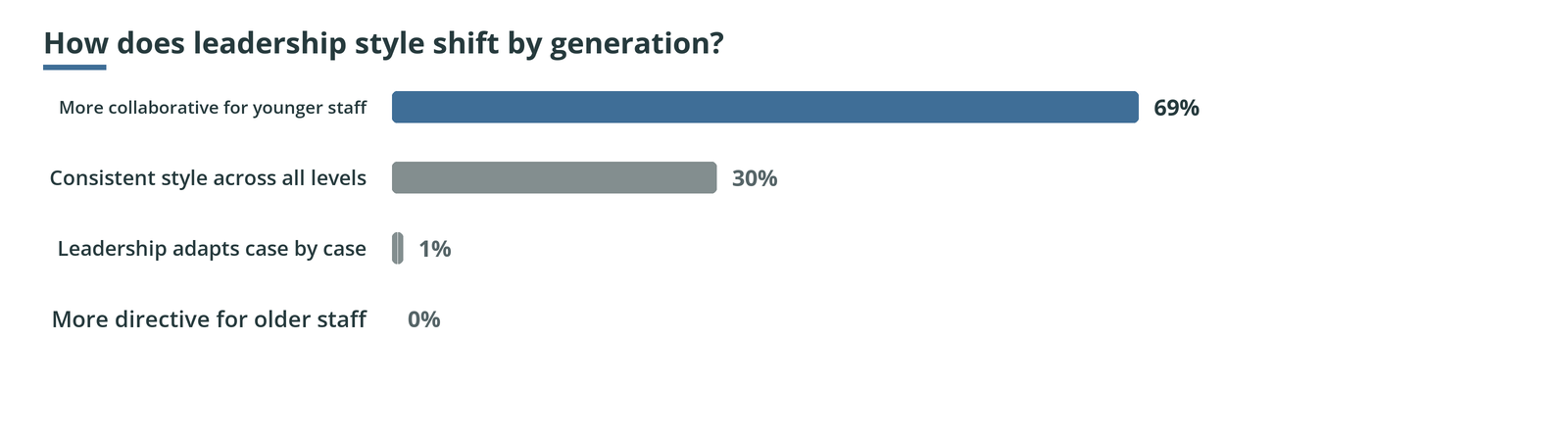
The zero is the most interesting number here. Not one leader in this sample described being more directive with older staff, which suggests that the direction of adaptation is settled even where the amount is not.
Roughly seven in ten adapt toward collaboration for younger employees. That fits research on generational motivations and communication styles showing Gen Y and Gen Z responding to flexible, supportive leadership while Baby Boomers are more comfortable with structure.
The 30% holding one style across all levels aren’t doing anything wrong. A single, predictable standard is legible to everyone and does not require a manager to guess a person’s age before deciding how to talk to them.
How do leaders handle generational stereotypes at work?
37% address stereotypes informally, case by case. 35% have not considered how to handle them, 27% do not actively address them, and 1% address them in training.
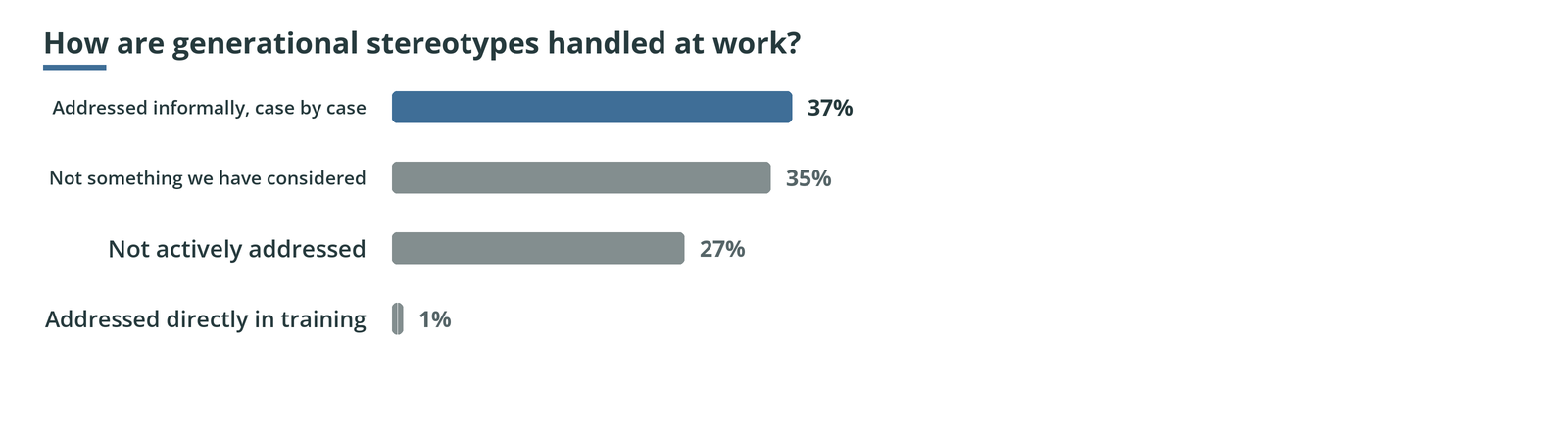
Add the two middle rows, and 62% have no approach at all: 35% have not considered it and 27% do not address it. That is the finding, and it sits awkwardly beside the 95% who described themselves as very prepared.
Informal, case-by-case handling is the most common approach, and it is better than nothing. It also depends entirely on the individual manager noticing, which means it works exactly as well as that manager’s judgment on the day.
Training at 1% is the number to notice. Age assumptions are among the few workplace biases that most organizations have never explicitly named, and a stereotype nobody has named is difficult for an employee to raise.
How is mentorship approached across generations?
72% named peer-to-peer mentoring, 11% named reverse mentoring, and 6% named traditional top-down mentoring. 10% have no formal program.

Mentorship has quietly stopped being a one-way transfer. Peer-to-peer at 72% describes knowledge moving sideways between people at similar levels rather than down from the most experienced person in the room.
Reverse mentoring at 11% is small but pointed, and it is the format that most directly addresses the technology gap this same group describes three sections later. WorldatWork treats mentoring and reverse mentoring as two halves of the same practice.
Traditional top-down mentoring at 6% is now the least common formal approach, which is a real shift from how most organizations described mentorship a decade ago.
Which generation drives AI tool adoption?
Baby Boomers drew the most discussion, and almost all of it was negative: 2% called them absolutely the main driver and 4% likely, against 21% not really and 30% definitely not. Gen X drew 22% of responses, split evenly. Gen Z and Millennials drew 8% each.

This chart needs its shape explained before its numbers. Each bar is the share of all responses that discussed that generation, so a long bar can be mostly disagreement. Baby Boomers have the longest bar in this chart and the most negative one.
What that says is narrower than “Boomers do not use AI.” It says that when these leaders discussed which generation drives AI adoption, they mostly discussed Baby Boomers in order to rule them out. The generations you might expect to lead, Gen Z and Millennials, barely came up at all.
That silence is the finding worth carrying. Research on generational technology adoption finds younger generations adopt AI more readily because of existing digital familiarity. This sample does not contradict that. It simply did not discuss it, most likely because it is assumed.
How fast does each generation adopt AI?
40% said younger employees adopt AI faster and 38% said older employees do. 20% said it is too early to tell, and 1% said adoption is fairly even.
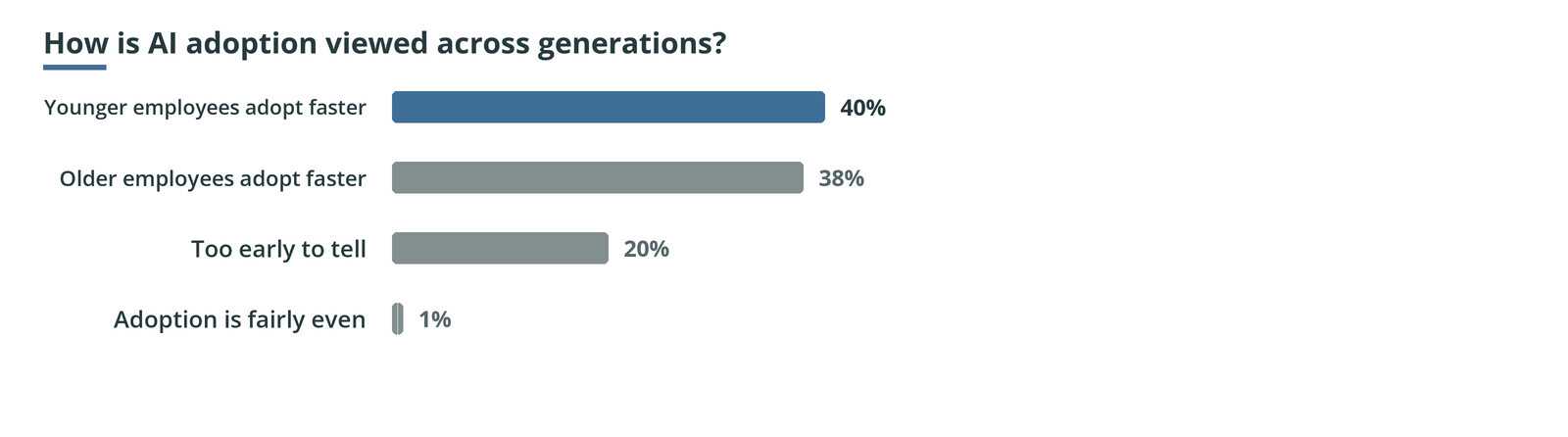
A two-point gap on a question this loaded is close to no answer at all, and that is more interesting than a clear result would have been. The assumption that AI adoption follows age does not hold up in this group’s own experience.
Usage data supports the same reading. A 2025 study from Protiviti and the London School of Economics found Gen Z at 83% workplace AI use and Millennials at 73%, with Gen X at 60% and Baby Boomers at 52%. Younger generations are ahead, and more than half of the two oldest cohorts are using AI at work.
Ahead is not the same as alone. A policy built on the idea that older employees need to be brought along, and younger ones do not need training, gets both halves wrong.
Where is the generational technology gap?
AI and automation tools showed the clearest gap: 33% called it major, 10% some, 12% minor, and 7% none. Collaboration platforms followed, with 14% calling the gap major. Project management software and communication apps drew far less.

The gap concentrates where the tools are newest. Nobody has ten years of habit with an AI assistant, so the differences that show up reflect willingness to experiment rather than accumulated skill.
Collaboration platforms sit second at 14% major, and communication apps barely register. Tools that have been in place long enough to become routine no longer separate people by age.
This section is also where the page argues with itself. Two sections up, this group split 40 to 38 on whether younger or older employees adopt AI faster, which is close to no gap.
Here, 33% call the generational gap in AI tools major. Both can be true if the gap is about attitude rather than speed. The tension is worth naming rather than smoothing over.
Which recruiting channel wins each generation?
30% said the best channel varies heavily by generation, and 19% called that a strong contender. Social media platforms were a strong contender for 3%, not the top choice for 16%, and ineffective for 24%.

The winning answer is that there is no single winning answer. Half of all responses landed on “it depends on who you are trying to reach,” which is a strategy rather than a channel.
Social media collects the most explicit rejection on the page: 40% of responses placed it below the top choice or called it ineffective. That is a strong signal for a channel that absorbs a large share of recruitment budgets.
Job boards and LinkedIn drew very little discussion in either direction, at roughly 5% of responses combined. In a sample gathered from public online conversation, quiet is ambiguous. It can mean settled, or it can mean nobody thought it was worth posting about.
Which generation is hardest to retain right now?
Millennials drew 94% of retention discussion: 5% called them definitely the hardest to retain and 54% probably the hardest, against 27% not the hardest and 8% definitely not. Baby Boomers drew 3%, and Gen Z and Gen X under 1% each.

Millennials are the retention story here by a distance, and the direction inside that bar leans clearly toward difficulty: 59% placed them as the hardest or probably the hardest, against 35% who did not.
This cuts against the more common headline. A 2025 report covered by Fortune found 45% naming Gen Z the hardest generation to work with. Hardest to work with and hardest to keep are different problems, and this sample makes it clear which one is on its mind.
The demographic reasons are unglamorous and mostly about timing. Millennials are now in the middle of their careers, which is where people are senior enough to be recruited away and junior enough to still be climbing, and where the pay gap between staying and moving is usually widest.
How confident are leaders in their succession plans?
Confidence split four ways at roughly 25% each: very confident, somewhat confident, not very confident, and no succession plan at all.

Half of this group is at or below “not very confident,” and a quarter has no plan at all. That is the number to sit with, particularly beside the 95% who described themselves as very prepared for a multigenerational workforce.
Succession is where generational change stops being a culture topic and becomes an operations one. It is the point at which institutional knowledge either transfers or leaves, and the window is set by other people’s retirement dates rather than by the planning calendar.
How optimistic are leaders about the multigenerational workplace?
34% were very optimistic and 34% somewhat optimistic. 32% were very concerned.

Roughly two-thirds optimistic, one-third seriously worried, with no middle ground between somewhat optimistic and very concerned. There is no mild concern in this data, which is a function of how the categories were recorded, and it makes the 32% read louder than a normal tail.
That third is not being pessimistic. Deloitte’s 2020 finding that 70% of organizations called this important while 10% felt ready describes the position a concerned leader is in: the problem is clear, the mandate is clear, and the preparation is not.
What this adds up to
Read in order, the page tells a consistent story about a group that feels ready and has not yet built much.
95% described themselves as very prepared. 62% have no approach to generational stereotypes; half are not confident in a succession plan; a quarter have no plan at all; and a third are very concerned about the future they just called themselves prepared for.
The specific findings are more useful than the confident ones. Age is a poor predictor of where people want to work and how fast they adopt AI. The technology gap that exists is concentrated in the newest tools, where it is a question of willingness rather than skill.
Mentorship has already turned sideways. Feedback splits evenly between the conversation and the record. The generation hardest to keep is the one in the middle of its career, not the one at the start.
The organizations that handle four generations well are usually the ones that stopped guessing from age and started asking.
Data compiled by Artios from public online conversations, 12 months to 14 August 2026, n=535,510. Not a survey. To discuss a generational session for your team, see executive sessions.
Posted: September 23rd, 2026
Categories: AI | Gen Z | Generations | Keynote Speaking | Research | Trends

Written by Jason Dorsey
Jason Dorsey is an acclaimed generations and behavioral researcher and speaker. He's received over 1,000 standing ovations for his unique keynote presentations. Jason has led over 200 research studies. Adweek calls him a "research guru." His mission is to deliver new insights and practical strategies that solve business challenges for leaders.