Generations Keynote Speech Statistics: USA 2026
Meeting planners talk publicly about what they want from a generations keynote speaker, and that conversation turns out to be a useful record of how the topic gets bought. This page collects 16 findings on how often planners book generational speakers, how far ahead they commit, what makes a speaker credible to them, and what they count as success afterward.
A generations keynote helps an audience make sense of how age, experience, and expectations shape the way people work, lead, communicate, and decide.
The sessions that land tend to cross the generational divide without flattening people into stereotypes or turning difference into conflict. They give an organization a clearer way to think about multigenerational teams, shifting workplace priorities, and the friction that shows up when several generations share a room.
How to read these numbers
This is an analysis of public conversation, not a survey, and is purely for informational purposes to advance perspective and insights into generational speakers and the generational speaking marketplace. Artios gathered the data and information by exploring 1,312,987 comments/opinions of what meeting planners in the United States said online across X, Quora, Reddit, Bluesky, TikTok, and Threads over the 12 months ending 24 July 2026. These were public postings of information, so no one was specifically asked a question, unlike a standard quantitative research study. The percentages describe opinions people volunteered in public online, which is a different perspective and approach from a representative sample answering a fielded instrument with a specific degree of rigor, clearly defined methodology, stated margin of error, and traditional quantitative research approach.
That distinction matters for how much weight any single figure can carry yet can be directionally helpful and informative for trends and points of view. Online conversation that is posted publicly online tends to over-represent people with a strong view and under-represent everyone who had no strong motivation to post. The bottom line is that these are interesting directional findings that can spark further conversation, academic exploration, and traditional research approaches rather than statements of hard facts.
For comparison, the national and international research studies designed, led, analyzed, and published by The Center for Generational Kinetics are specifically created, worded, participant weighted, fielded, and analyzed with rigor to a highly specific sample and usually weighted to the U.S. Census or another Census benchmark depending on the geography or participant group focus. The research-based insights uncovered by The Center for Generational Kinetics are much more rigorous in design, scope, fielding, and analysis, and they are labeled as such wherever they appear.
Index
- Methodology and data
- Among meeting planners, 52% book a generations keynote speaker once a year, 15% book one several times a year, 15% include one at every event, 3% do so rarely, and 15% never book generations keynote speakers.
- Corporate conferences are the industry events that 34% of meeting planners think they most need a generations keynote speaker, 29% think they are most needed at healthcare conferences, 22% at higher education events, and 12% at association meetings, while 3% think generations keynote speeches are essential at sales kickoffs, and 1% at government and nonprofit events.
- For 73% of meeting planners, the top priority when booking a generations keynote speaker is engaging and inspiring attendees, while another 9% consider it an important goal. By comparison, 4% say it is not a main focus, 12% say it is not a goal at all, and only 2% identify improving team communication as their top priority.
- Finding the right fit is a significant challenge for 83% of meeting planners when booking a generations keynote speaker, and this is a minor challenge for 16%, while none discuss the challenges of budget constraints, stakeholder buy-in, measuring ROI, or content relevance.
- 65% of meeting planners book a generations keynote speaker over 12 months in advance, 10% book between 3 and 6 months in advance, another 10% between 1 and 3 months ahead of time, and 8% book between 6 and 12 months prior to an event, and the remaining 8% book under a month beforehand.
- 94% of meeting planners typically discover speakers for a generations keynote via the speakers’ own websites, 4% discover speakers at industry conferences, and 2% via social media and LinkedIn.
- Speaker research credibility is extremely important for 36% of meeting planners when choosing generations keynote speeches, and this credibility is very important for 30% and somewhat important for 2%, but it’s not very important for 30%, and not important at all for 2%.
- Post-event workshops are the most influential added value for 48% of meeting planners when booking a generations keynote speaker, and 28% agree they have some influence on their decision, but these post-event workshops have no influence on 5%, while 17% agree that media and press coverage are the most influential added value, and 2% agree that custom content for their audience has some influence.
- 14% of meeting planners agree that virtual-only generations keynote speeches are the worst format choice, and 18% share the same sentiments about hybrid speeches, while 14% think having no preference is a good option, 54% disagree, citing this as the worst choice.
- An audience of under 100 people fits generations keynote speeches the best for 55% of meeting planners, yet 15% prefer an audience of over 5,000 people, 15% between 1,000 and 5,000 people, and 15% agree that 500 to 1,000 people is the best fit.
- For 15% of meeting planners, recruiting Gen Z is an extremely relevant topic that resonates the most in generations keynote speeches, 35% agree this topic is quite relevant, and another 33% say it’s somewhat relevant, but 17% don’t find it relevant at all.
- AI hasn’t changed 61% of meeting planners’ approach to generations keynote speeches at all; however, 33% are using AI for content customization, and 6% for speaker vetting research.
- 20% of meeting planners say that speakers never use AI tools during generations keynote speeches, but 3% don’t think this is true at all, 24% agree speakers use AI tools occasionally, 24% aren’t really sure, and 22% agree they rarely use these tools, but 2% don’t think this is true, and 2% think it’s somewhat true that speakers use AI tools during their speeches extensively.
- 74% of meeting planners agree that no AI features are needed in generations keynote speeches because they wouldn’t help, and 23% believe they wouldn’t make a big impact, while 2% think they could help speakers.
- 95% of meeting planners measure the success of a generations keynote speech by the buzz it creates on social media, 3% measure success by repeat booking requests, 2% by post-event engagement, and 1% by attendee survey scores, with the remaining 1% measuring speech success by sales or retention metrics.
- 78% of meeting planners think that multigenerational teams will be a defining trend for generations keynote speeches in 2027, and 17% think these teams will be influential, while 5% believe AI-personalized content will have some impact.
How often do meeting planners book a generations keynote speaker?
Booking once a year was the most common pattern in the conversations analyzed, at 52%, while 15% described booking for every event and another 15% said they never book one.

Booking frequency is a decent proxy for where the topic sits among a planner’s priorities. At one booking a year, generational insight reads as a regular strategic update: a chance to revisit how customer expectations, communication preferences, and buying behavior are shifting across age groups.
The planners describing a speaker at every event, and those booking several times a year, put the subject closer to the center of their programming. Repeat sessions can go somewhere a single keynote cannot, moving from a general introduction into specific problems like reaching customers across age groups or easing friction inside multigenerational teams.
The 15% who never book and the 3% who rarely do are worth noticing for a different reason. Their audiences may be getting that context somewhere else, or the agenda may simply be full.
Which industry events most need generational keynote speeches?
Corporate conferences led at 34%, followed by healthcare conferences at 29% and higher education events at 22%.

The events that came up most often are the ones where age-based differences shape communication, expectations, and decisions.
Corporate conferences bring together employees, managers, and executives at very different career stages, which gives generational insight somewhere practical to land: collaboration, leadership pipelines, customer understanding, culture.
Healthcare conferences follow closely. Published research in the National Library of Medicine points to generational differences in how people perceive health, make care decisions, use digital tools, and think about prevention. A generational keynote can help clinicians and administrators understand why the same message or care pathway lands differently across age groups.
Higher education events come next. Colleges and universities work across students, faculty, administrators, alumni, and employers whose expectations around learning, communication, technology, and work can sit far apart.
Where generational insight is shaping agendas
Association meetings registered at 12%. Membership spans generations and career stages, so associations have to keep education, networking, leadership paths, and communications relevant across a wide span at once.
Sales kickoffs came in at 3%, where generational insight bears on how different buyers research a purchase, build trust, and prefer to be contacted.
Government and nonprofit events registered at 1%. These organizations serve age-diverse communities and employ multigenerational teams, so the low figure likely says more about who posts publicly about event planning than about how relevant the topic is to the work.
What is the primary goal when booking a generations keynote?
Engaging and inspiring attendees was the dominant stated goal at 73%, with 9% calling it an important goal. Improving team communication was named as a top priority by 2%.

The goal planners talk about most is the experience in the room. Generational material lends itself to recognizable stories, shared humor, and moments where people see themselves and their colleagues clearly, which gives a speaker room to hold an audience while shifting how those people see the colleagues and customers they deal with every day.
The 2% naming team communication is the more interesting number, given how much attention the subject gets elsewhere. The World Economic Forum has noted that five generations are working alongside each other for the first time, each arriving with different expectations and different relationships to technology, and argues that future-ready organizations need to build collaboration across those groups.
One reading is that planners treat communication improvement as an outcome of a good keynote rather than the reason to book one. Nothing in this data settles that, and it would be a useful thing to ask directly.
Boosting employee engagement did not come up at all in the conversations analyzed.
What is the biggest challenge in booking a generations keynote?
Finding the right fit was described as a significant challenge by 83% and a minor one by 16%. Budget constraints registered below 1%.

The obstacles planners actually talk about are narrower than the ones a booking process usually anticipates.
Fit dominates. With engagement as the stated goal, a generations keynote needs a speaker who can make age-based differences recognizable without reducing anyone to a stereotype. Tone, examples, humor, and experience all have to suit the room.
A poor fit can leave a session feeling simplistic or divisive rather than useful, which is a harder problem to fix than a fee.
Budget barely registered. One plausible reading: once a planner finds someone who can handle the subject with credibility and nuance, price is less likely to end the conversation.
Stakeholder buy-in, measuring ROI, and content relevance did not come up. These are exactly the challenges a planner might be expected to raise, and their absence is more likely a limit of public conversation than evidence that they never arise.
How far in advance do meeting planners book a generations keynote?
Booking more than 12 months out was the most common pattern at 65%, with 8% booking under a month before the event.

A long runway gives planners room to secure a speaker, tie the keynote to the event theme, coordinate promotion, and allow time for customization or pre-event input. Add the 8% booking six to 12 months ahead and roughly three-quarters of this conversation is happening at least half a year out.
Another 20% book somewhere between one and six months out, after the broader event structure has taken shape. The keynote can still be integrated, with less room for extended preparation.
The remaining 8% book inside a month. Those decisions tend to follow a cancellation, a gap in the agenda, or a need that only becomes clear close to the date, and they put a premium on availability and a topic that is ready to deliver.
How do meeting planners discover generations keynote speakers?
Speaker websites were named far more than any other route at 94%, ahead of industry conferences at 4%, social media and LinkedIn at 2%.
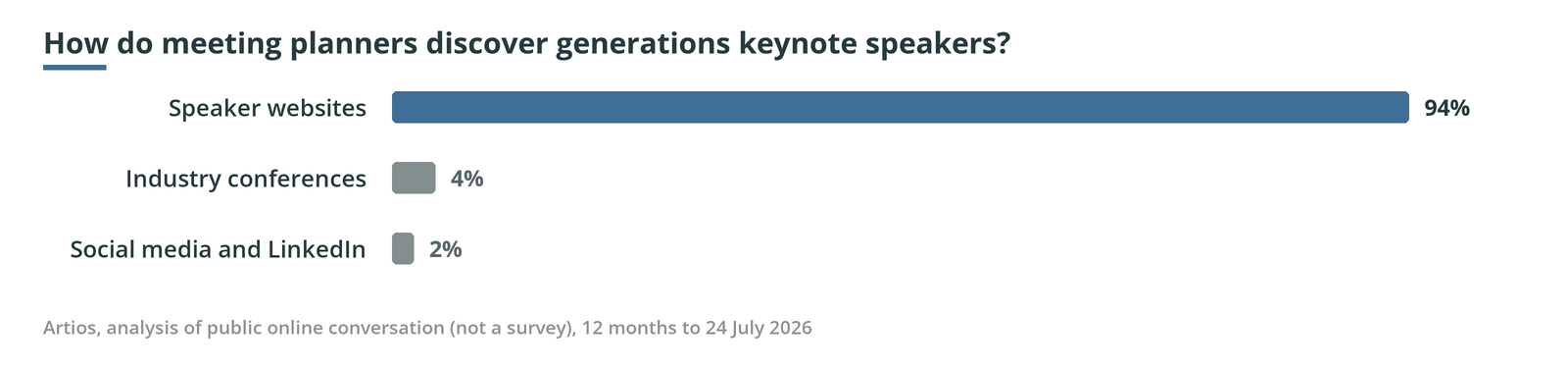
The concentration here is worth pausing on, and it is also one of the figures most likely to reflect where this conversation was collected. People posting publicly about finding a speaker are describing a self-directed search, which is not the only way a booking gets made.
Taken at face value, it puts considerable weight on the website. Research covered by the Springfield Business Journal suggests a visitor forms an impression of a site in a fraction of a second, so positioning, keynote footage, relevant testimonials, recognizable client experience, and straightforward booking information have to do their work quickly. The site is carrying much of the first conversation before anyone makes contact.
Industry conferences let a planner judge stage presence, delivery, and whether content holds a real room. Social platforms can introduce a perspective, though planners generally look for stronger proof before handing someone a stage.
How important is a speaker’s research credibility?
Research credibility split the conversation. It was called extremely important by 36% and very important by 30%, while 30% called it not very important and 2% not important at all.
This is the most divided finding on the page, and the split is the finding. Two-thirds of this conversation treats a generational keynote as evidence-led. Nearly a third treats it as an experience carried mainly by delivery, and any speaker who assumes the room shares one view of that is guessing.
For the planners who do weight it, Harvard Professional Development reports that 68% of people regard someone with genuine expertise in their field as a thought leader, and that people who trust a leader engage at several times the rate of those who do not. Well-supported research gives an audience a reason to trust the conclusions behind the stories told onstage.
For the planners who weight it less, the implication is not that research is unwelcome. It is that research alone will not carry a session that does not connect.
Which added value most influences a booking decision?
Post-event workshops were the most influential add-on for 48%, with 28% describing some influence. Media and press coverage was most influential for 17%.

A workshop gives attendees room to test a keynote’s ideas against their own workplace, customers, and communication problems, turning a broad session into discussion and next steps that are easier to carry back to a desk.
Media and press coverage delivers value outside the room by raising the event’s profile and extending the conversation to people who were not there, which matters most when an event needs public visibility.
Custom content for the audience registered at 2% for some influence. The most likely explanation is that planners already assume a speaker will tailor examples to the room, so tailoring reads as part of the job rather than as an extra.
What format works best for a generations keynote?
The clearest signal here is negative: 54% described having no format preference as the worst choice. Hybrid was called the worst choice by 18% and virtual-only by 14%.

This question is easier to read backwards. Planners were not converging on a favorite format so much as rejecting the idea of being indifferent to format, which suggests they see the delivery mode as a decision that shapes whether generational material works rather than a logistical detail.
Virtual-only and hybrid each drew criticism, which cuts against the direction of the market: Grand View Research projects virtual events growing from roughly $145 billion in 2026 to $472.9 billion by 2033. Generational content leans on reading a room and on shared recognition, both of which are harder through a screen.
In-person does not appear in this data. No planner in the conversations analyzed rated it, in either direction. The most reasonable interpretation is that in-person is the assumed default and people rarely post about a default.
What audience size fits a generations keynote best?
Audiences under 100 were named most often at 55%, with the remaining preferences split evenly at 15% each across 500 to 1,000, 1,000 to 5,000, and over 5,000.

Bigger is not automatically better here. A smaller room gives a speaker space to read reactions, adjust delivery, and make generational examples feel specific, and it lets a keynote take on a more conversational quality where people recognize themselves and each other in the stories.
The larger sizes each carry their own demands. Between 500 and 1,000, a shared experience is still available but needs firmer structure. From 1,000 to 5,000, the keynote has to unify people across roles, ages, and expectations, which puts a premium on broadly recognizable examples. Above 5,000, energy, pacing, visual support, and ideas that land fast all matter more.
Audiences between 100 and 500 were not among the options in this data.
Which generational topic resonates most in a generations keynote?
Recruiting Gen Z was rated at least somewhat relevant by 83% of this conversation: extremely relevant for 15%, quite relevant for 35%, and somewhat relevant for 33%. It was called not relevant by 17%.
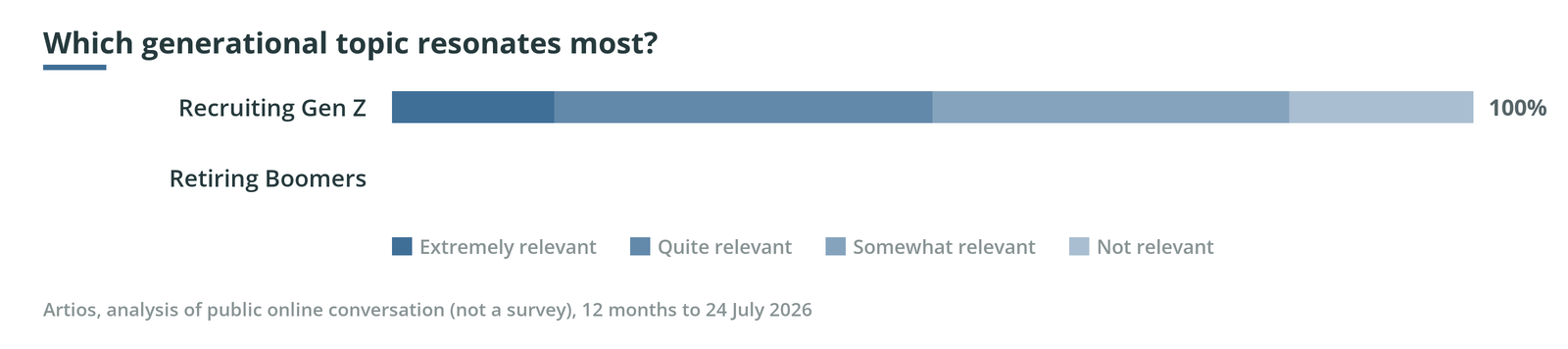
The topics that resonate tend to sit where employers feel the most immediate pressure. The breadth of interest here reflects a difficult moment for attracting younger workers: the World Economic Forum reports that Gen Z is facing sharper competition for work than previous generations, with global entry-level job postings down 29 percentage points between January 2024 and September 2025.
A generations keynote can help an employer look honestly at whether its roles are visible to younger candidates, whether its career paths read as clear, and whether its recruitment message speaks to what those candidates actually expect from work.
Retiring Boomers did not come up in the conversations analyzed. Succession planning, knowledge transfer, and workforce transition remain live issues for most organizations, so this more likely reflects what gets posted publicly rather than what matters.
How has AI changed the approach to generations keynotes?
AI had not changed the approach at all for 61%. Content customization accounted for 33% and speaker vetting research for 6%.

The picture is uneven rather than transformed. Most planners in this conversation still define the event’s needs themselves, assess speakers through websites and keynote footage, and talk content through directly with the person who will deliver it. Generative tools have not displaced the judgment involved in choosing a speaker or deciding what a room needs.
Content customization is where AI has found the most traction, helping identify industry-specific examples, refine themes, draft audience questions, or adapt supporting material more quickly.
Speaker vetting sits lowest. AI can accelerate a comparison and summarize public information, and the low figure suggests planners are still cautious about trusting it to judge credibility, delivery, or suitability for a live audience.
Do speakers use AI tools during generations keynotes?
No clear consensus emerged. Roughly a quarter of this conversation each said speakers never use AI tools, rarely use them, use them occasionally, or were not sure.

The even split is the finding. Planners are not observing a settled practice, and a meaningful share cannot tell whether AI is being used at all, which suggests that where AI does appear onstage it is not appearing as AI.
Where use is more visible, it still tends to be occasional: a live demonstration, a generated example, an audience interaction. Extensive use sits at the far edge of the picture, named by very few. Building a keynote heavily around AI risks pulling attention away from the speaker’s stories, judgment, and connection with the room, which are the things a generational session depends on.
Which AI feature would improve a generations keynote most?
74% said no AI feature is needed because it would not help, and 23% said one would not make much impact. 2% thought a feature could help.
This reads less like resistance to the technology and more like an absence of an obvious job for it to do.
Guidance on AI-supported conference presentations tends to recommend introducing tools gradually, starting with a specific weakness such as slide design before moving into preparation, interactive features, or data visualization. The emphasis falls on solving a defined problem rather than adding technology for its own sake.
When a keynote already delivers strong stories, clear insight, and a speaker who connects, planners may simply not see the gap.
Live translation registered below 1%. It can be genuinely valuable for multilingual and international audiences, and it addresses a narrow need that will not apply to every event.
How do meeting planners measure the success of a generations keynote?
Social media buzz was named by 95%, ahead of repeat booking requests at 3%, post-event engagement at 2%, and attendee survey scores and sales or retention metrics at 1% each.

This is the most lopsided finding on the page and also the one to hold most loosely, since a conversation collected from social platforms will naturally over-represent people who think in terms of social signals.
Read directionally, it still says something. Posts, mentions, shares, and clips give an organizer immediate evidence that a keynote cut through, and immediacy is worth a great deal when the next event is already being planned. The limitation is that online activity measures visibility rather than learning, application, or durable value.
The quieter measures capture different things. A repeat booking request is a commercial signal that a session created real demand. Post-event engagement shows whether ideas stayed active after people left the room. Survey scores give direct feedback while the experience is fresh. Sales and retention metrics aim at business outcomes, though isolating one session from everything else moving through a market is genuinely difficult.
Which trend will shape generations keynotes in 2027?
Multigenerational teams were named a defining trend by 78%, with 17% expecting them to be influential. AI-personalized content was expected to have some impact by 5%.

Age-diverse teams pair institutional knowledge and strategic judgment with fresh thinking and adaptability, which the Age Diversity Forum links to stronger decision-making and problem-solving. They also open the door to knowledge moving in both directions, with experienced employees sharing hard-won context while newer colleagues bring different instincts about technology and ways of working.
For a speaker, that points somewhere specific. An audience arriving in 2027 will have heard the broad descriptions of how generations differ. What it will want is help making a team of five generations work on a Tuesday.
AI-personalized content drew limited expectation. Personalization on its own does not guarantee relevance: it can help adapt parts of a keynote to the roles and industries in the room, and the content still has to feel human to the people hearing it.
What this adds up to
Read together, these 16 findings describe a buyer with a clear pattern. Planners commit early, judge fit above almost everything else, do most of their assessment on a speaker’s own website, and split down the middle on how much the underlying research matters.
The tension worth sitting with is between the goal and the measure. Engagement is the reason planners give for booking, and social buzz is what they count as proof it worked.
Meanwhile the outcomes that would show a keynote changed anything, such as repeat requests, sustained engagement, and retention, barely register. That gap is an opening for any speaker willing to help an organizer measure something more durable than the reaction in the room.
A generations keynote earns its place on the agenda when it gives an audience something practical to do on Monday, not just something to post about on Friday.
Data compiled by Artios from public online conversation, 12 months to 24 July 2026. Not a survey. To discuss a generations keynote, see speaking.
Posted: August 20th, 2026
Categories: AI | Gen Z | Generations | Keynote Speaking | Research | Trends

Written by Jason Dorsey
Jason Dorsey is an acclaimed generations and behavioral researcher and speaker. He's received over 1,000 standing ovations for his unique keynote presentations. Jason has led over 200 research studies. Adweek calls him a "research guru." His mission is to deliver new insights and practical strategies that solve business challenges for leaders.