Top Generations Keynote Speakers Statistics: USA 2026

Choosing a keynote speaker for a workforce spanning several generations is a judgment call made largely on incomplete evidence. Executives are assessing whether someone can hold a room they have never seen, on a subject where getting it slightly wrong can cause a meeting to go a direction that no one intended.
This page collects 11 findings on how they go about it: where the search starts, which evidence they trust, when in the planning cycle they begin, what proves expertise, and what actually decides the booking.
How to read these numbers
This is an analysis of public conversation, not a survey. Artios gathered it by profiling what executives in the United States said online across X, Quora, Reddit, Bluesky, TikTok, and Threads over the 12 months ending 24 July 2026. Nobody was asked a question. The percentages describe opinions people volunteered in public.
This sample is narrow. By its own demographics, 84% are based in Dallas and 60% work in healthcare and life sciences. Read it as one group’s conversation rather than a national picture.
For comparison, the national and international research studies designed, led, analyzed, and published by The Center for Generational Kinetics are specifically created, worded, participant-weighted, fielded, and analyzed with rigor to a highly specific sample and usually weighted to the U.S. Census or another Census benchmark depending on the geography or participant group focus. The research-based insights uncovered by The Center for Generational Kinetics are much more rigorous in design, scope, fielding, and analysis, and they are labeled as such wherever they appear.
Index
- Where the search starts
- Which resource is trusted when identifying candidates
- When in the planning process the search begins
- Challenges faced when booking
- What matters when evaluating expertise
- Whether authored research matters
- How audience engagement is judged
- What most influences the final decision
- Which industries this sample covers
- What job titles it holds
- Where it is based
Where does the search for a generation’s keynote speaker start?
Google was the starting point for 73% of this conversation, ahead of peer referrals at 23%.

An open search dominates here, which fits Google’s general position: it reaches an estimated 270 million Americans and holds roughly 87% of the US search market.
The practical consequence is that whatever a search returns does the introducing. Positioning, keynote footage, and evidence of relevant experience are carrying the first conversation before anyone makes contact.
Peer referrals come second and behave differently. A recommendation arrives with context that a search result cannot supply: how the speaker handled a comparable room and whether they served the event’s goals.
Which resource is trusted when identifying candidates?
Past conference programs and speaker lineups drew the widest engagement: a top resource for 9%, a good option for 20%, though not a first choice for 25% and distrusted by 2%.
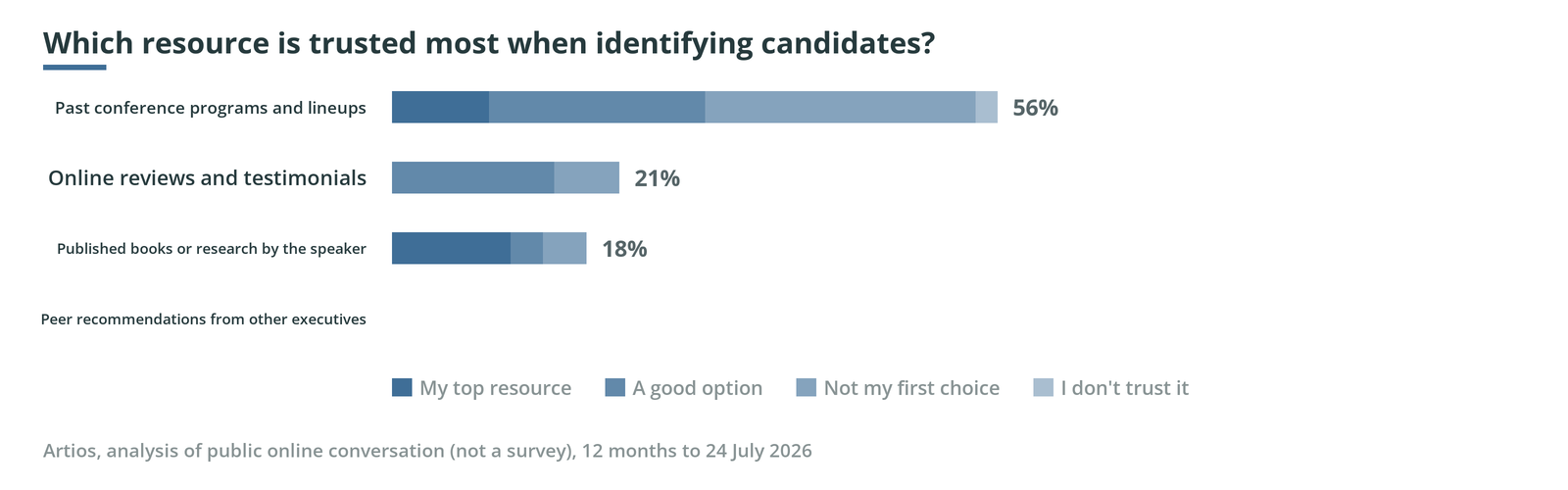
Every resource in this question drew as much rejection as endorsement, which is the finding. No source of evidence has this group’s confidence.
A conference roster works as secondhand vetting. Another organizer already assessed the speaker and gave them a stage, and the surrounding program says something about which stage.
Published books or research were a top resource for 11%, the highest first-choice share of anything here. Online reviews and testimonials were a good option for 15% but the leading resource for almost nobody, which sits at an odd angle to consumer behavior more broadly: Business Wire reports more than half of consumers consult reviews first, and 77% consider them mostly trustworthy. A booking decision appears to be held to a different standard.
When in the planning process does the search begin?
Several months before the event date was called the best time by 26%, with 10% calling it a good time. Beginning as soon as the previous year’s event concludes was the best time for 14%.
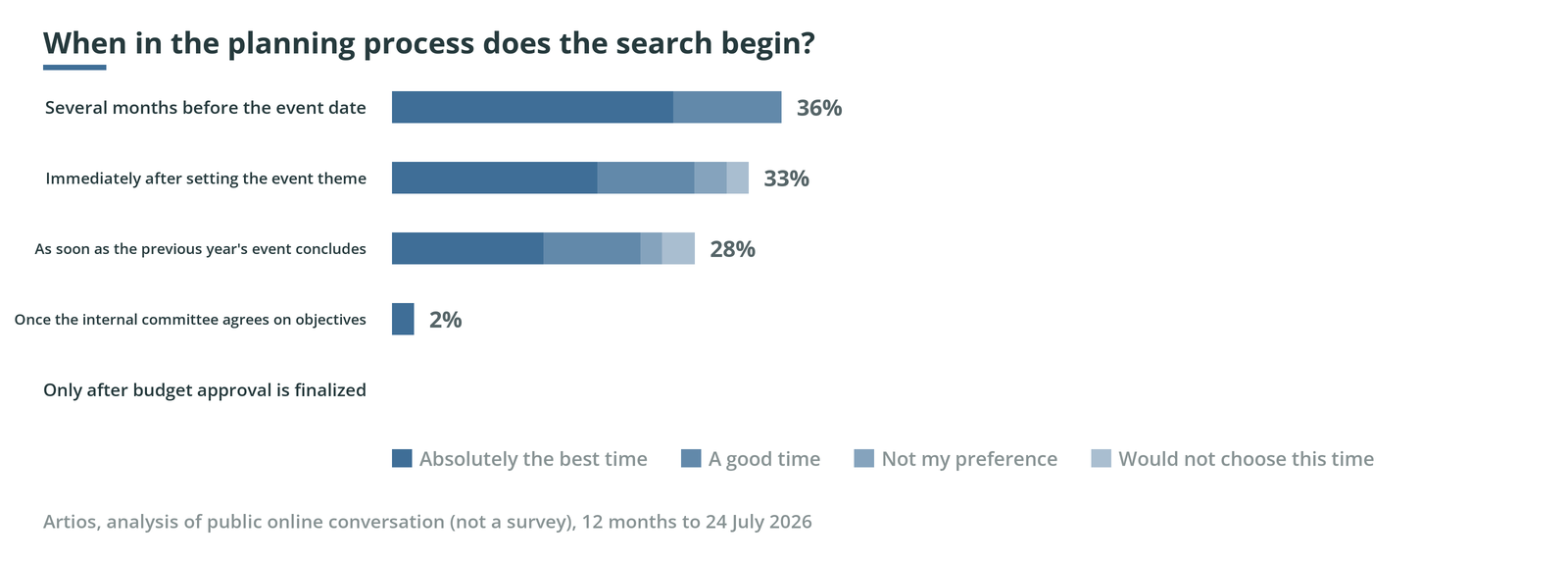
The search reliably begins before the event has taken full shape. Adding those who start immediately after the theme is set, most of this conversation is about finding a speaker while the program is still being decided, which gives the speaker room to shape content around the event rather than fit into a finished agenda.
Starting right after the previous year’s event is the early end of the range, and it treats speaker selection as a standing part of the annual cycle rather than a task that opens when planning does.
Waiting for the internal committee to agree on objectives was the preferred point for 2%.
Nobody named waiting for final budget approval. For a group that later describes budget as a strong influence on the decision, that is a useful piece of sequencing: the looking starts well before the money is settled.
What challenges have come up when booking a speaker?
Uncertainty about audience engagement was the leading challenge, major for 28% and somewhat challenging for 15%. High fees relative to perceived value were a major challenge for 17%.

The dominant worry is not cost. It is not knowing whether the room will respond, which is the hardest thing to establish from the outside and the thing every other question on this page circles back to.
That concern has a business logic behind it. Gallup’s research links highly engaged teams to stronger business results across customer loyalty, productivity, and profitability, so an executive weighing a keynote is weighing whether it moves anything.
Fees come second, and are framed as value rather than price: high relative to perceived value. The objection is to uncertain return, not to the number.
Lack of customization barely registered as a problem, with 16% saying it posed no challenge at all. Read alongside the final-decision question, where customization drew no discussion whatsoever, the likeliest explanation is that tailoring is assumed rather than valued.
What matters most when evaluating a speaker’s expertise?
Published thought leadership was called absolutely essential by 32%, with real-world corporate experience close behind at 28% essential and 17% very important.
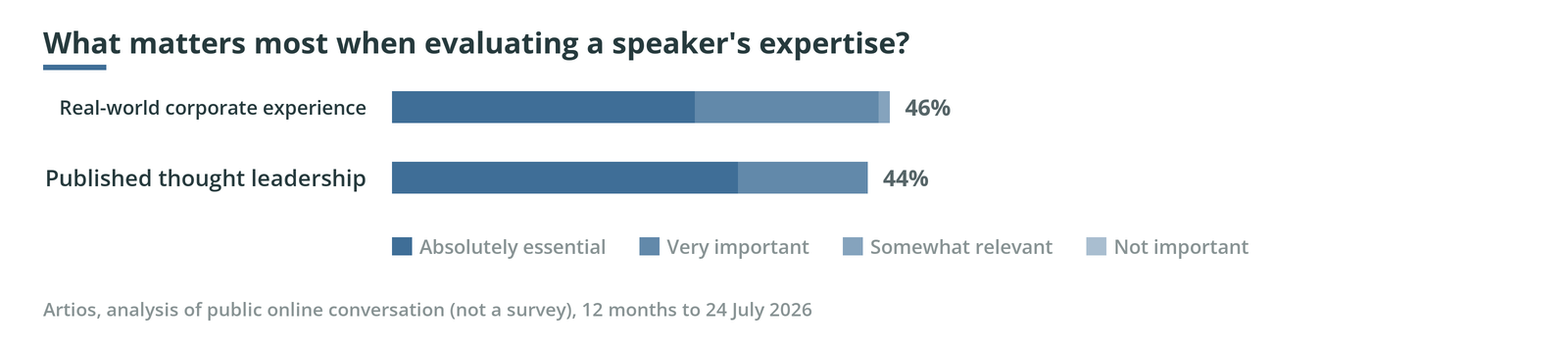
These two run neck and neck, and which one leads depends on how you read the question. Thought leadership leads on “absolutely essential”. Corporate experience edges ahead once “very important” is added, at 45% against 44%.
Treating them as a pair is the more useful reading. Published work establishes that someone has thought about the subject beyond a talk track. Corporate experience establishes that they have had to act on it inside a real organization with real constraints.
How important is it that the speaker has authored research or books?
This split almost evenly four ways. 25% called authorship not a significant factor, 24% said it only matters paired with strong stage presence, 23% called it somewhat important, and 22% called it extremely important.

A near four-way tie is an unusual result and the most honest thing on the page. There is no consensus on whether written credentials matter.
The largest single group discounts authorship. The next largest accepts it only in combination with delivery. Together, roughly half of this conversation treats published work as insufficient on its own, while a further fifth treats it as validation of genuine expertise.
For a speaker, the practical implication is that credentials do not travel by themselves. Only 6% ranked authored work as less important than live engagement outright, so this is not a rejection of research. It is a demand that research show up in the room.
How is a speaker’s ability to engage a multigenerational audience judged?
79% assess it through interactive session style, 20% by watching past keynote footage.

Engagement is judged by watching someone engage, which sounds obvious until you set it against the previous question. This group is not confident that books prove capability, and here they say plainly what does: evidence of a speaker working with an audience rather than at one.
SHRM notes that communicating across generations calls for flexibility and a recognition that people engage in different ways, which is exactly what an interactive session makes visible and a biography does not.
Past keynote footage does similar work at one remove, letting an executive judge delivery and sustained attention before committing.
What factor most influences the final decision?
Budget and fee structure were a strong influence on 63% and somewhat mattered to 29%, while being the outright deciding factor for only 1%.

Budget shapes nearly every decision here and settles almost none of them. Just 7% called it unimportant, so it is close to universal as a consideration and close to absent as a verdict.
That balance is easier to understand given the range in the market. Professional keynote fees typically run between $5,000 and $50,000 depending on experience and expertise, which is wide enough that a fee alone tells an executive very little.
What is the primary industry of this sample?
60% work in healthcare and life sciences, 32% in manufacturing and industrial, and 8% in financial services and banking.
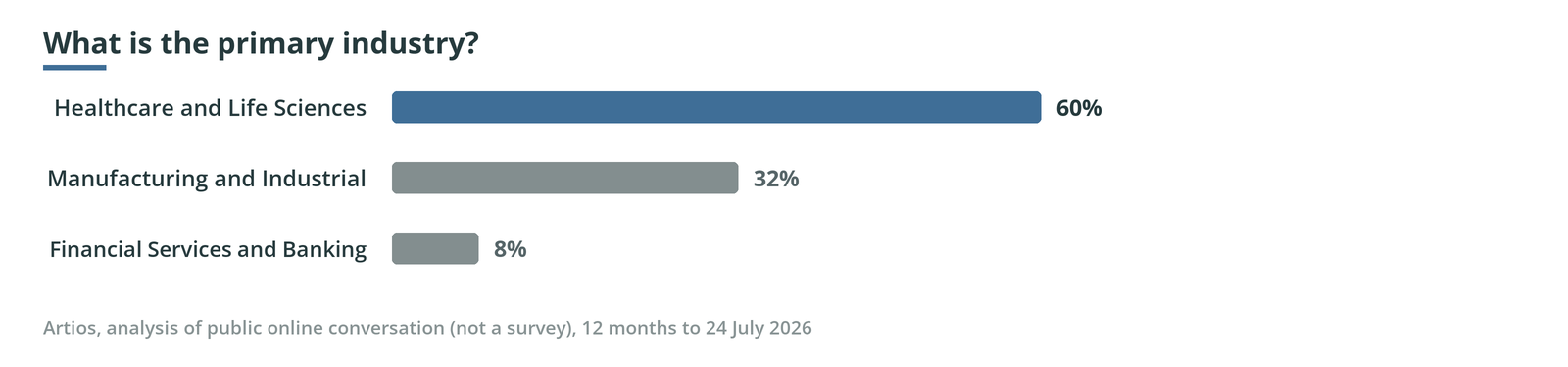
This concentration is the main limit on the page, and a fair illustration of how much this method depends on who happened to be posting.
Healthcare’s share is at least plausible on its own terms. Up to five generations work side by side in parts of the sector, across very different levels of experience and comfort with new technology.
Manufacturing carries a comparable mix, with long-tenured employees working alongside people entering skilled roles that have changed since the last generation learned them.
What is the current job title in this sample?
Chief learning officers make up 51%, chief executive officers 27%, and chief operating officers 22%.
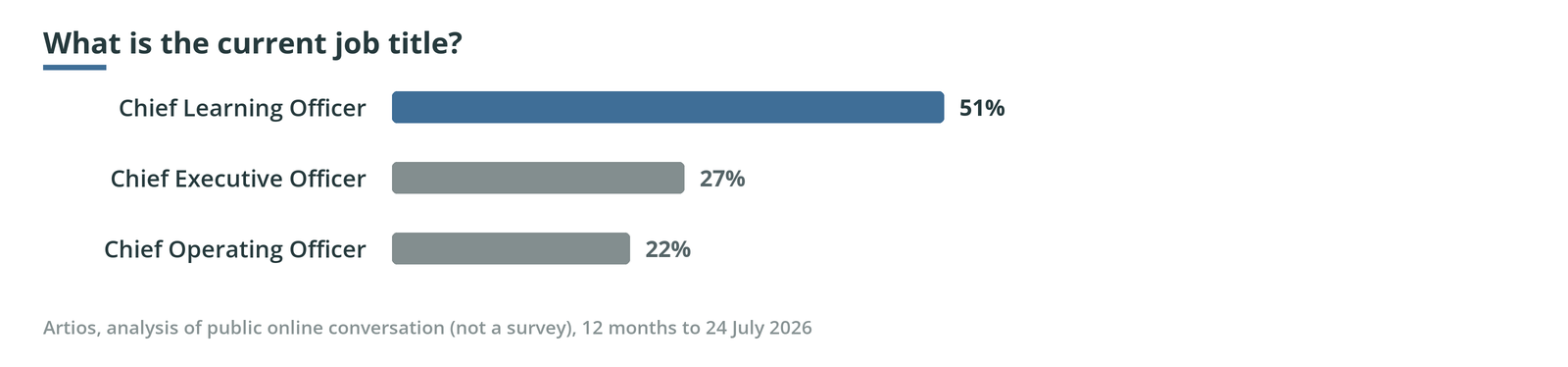
This group is senior, and the distribution suggests where generational sessions get decided.
Chief learning officers leading at half the sample places these bookings inside a development agenda rather than an events one, where a keynote is expected to connect to something ongoing.
The chief executive share is the more unusual number. Direct CEO involvement in speaker choice suggests the session carries a message leadership wants delivered, not just an agenda slot to fill.
Chief operating officers bring the operational question: whether the session improves how the organization actually runs.
What city is this sample based in?
84% are based in Dallas, 12% in Atlanta, 3% in Los Angeles, and 1% in Chicago.
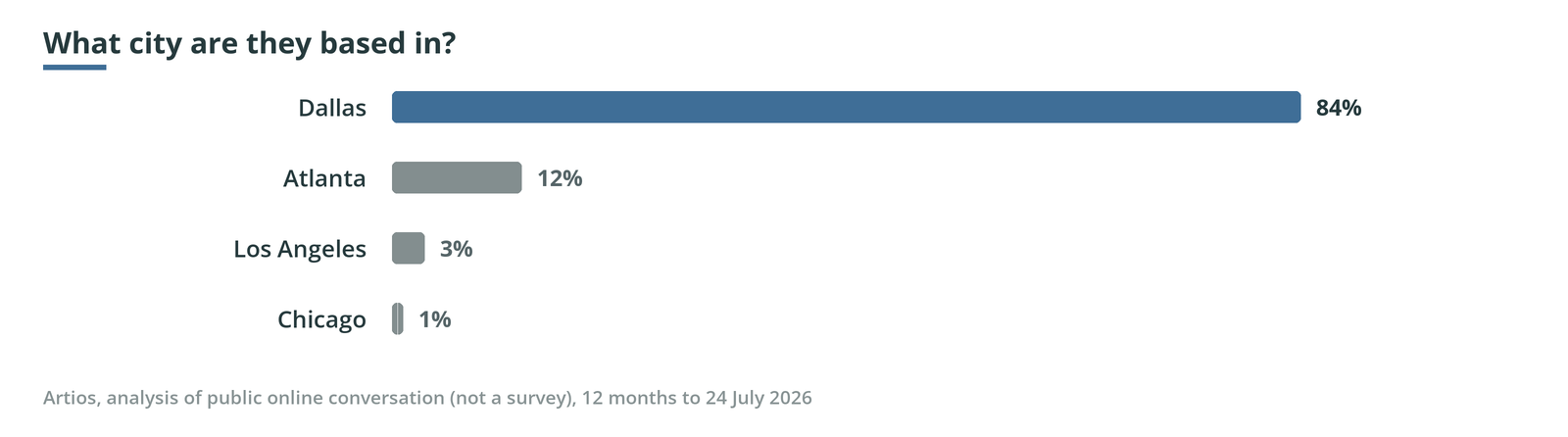
A single metro accounting for more than four-fifths of a sample is the clearest signal on this page that these are findings about a conversation rather than a demographic in our country.
Dallas has been ranked the leading US city for corporate headquarters relocations, across healthcare, finance, technology, and manufacturing, so a concentration of executive conversation there makes sense. Eighty-four percent of it in one metro does not.
What this adds up to
The pattern across these findings is an executive who wants proof of the room. They search openly rather than through networks, they distrust every category of evidence to some degree, they split evenly on whether credentials matter, and then they say clearly that what convinces them is watching someone hold an audience.
Budget sits underneath all of it as a constraint rather than a decision. What they are really buying is confidence that a subject with real potential to go wrong will be handled by someone who has handled it before.
Credentials get a speaker considered. Evidence of the room gets them booked.
Data compiled by Artios from public online conversations, 12 months to 24 July 2026. Not a survey. To discuss a generation’s keynote, see speaking.
Posted: October 5th, 2026
Categories: AI | Gen Z | Generations | Keynote Speaking | Research | Trends
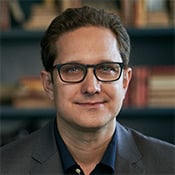
Written by Jason Dorsey
Jason Dorsey is an acclaimed generations and behavioral researcher and speaker. He's received over 1,000 standing ovations for his unique keynote presentations. Jason has led over 200 research studies. Adweek calls him a "research guru." His mission is to deliver new insights and practical strategies that solve business challenges for leaders.